

Executive summary
Asian venture capital is back, but it has come back in a shape that most allocators are not yet positioned for. Startups across Asia raised roughly $108.7 billion in the first nine months of 2026, already 61% more than in the whole of 2025 and the strongest run since the 2021 peak (Crunchbase). Yet the recovery is narrow. About 70% of third-quarter dollars went to China, about 55% to AI companies, and deal counts barely moved.
We call this Asia’s own great divergence: a widening gap between the handful of companies that can raise billions and the long tail of capable founders who cannot raise at all. In our previous paper, Allocator One framed the global version of this split as the theme of the 2026 Alpha Summit (Allocator One). Our argument is that in Asia the divergence is not only a risk to manage. It is the source of the best entry prices in a decade.
The opportunity sits with what we call Asia’s venture hidden champions. We borrow the term from Hermann Simon, who used it for mid-sized, little-known companies that lead their global niche. In a venture context, we mean companies that are building category leadership in an unglamorous layer of Asia’s real economy, that reach revenue on modest capital, and that are too small or too specialised for the megafunds to notice.
Key findings
- The cycle has turned, but only at the top. Asia’s quarterly startup funding reached $42.8 billion in Q2 2026 and $38.5 billion in Q3, the two strongest quarters in more than three years. Concentration, not breadth, drove both.
- Southeast Asia and India show the divergence most clearly. Southeast Asia raised $7.25 billion in H1 2026, but a single $4.5 billion data-centre round accounted for most of it. India’s funding rose 7% in the first nine months, while funding rounds fell 38% and seed funding fell 37%.
- North Asia is structurally re-rating. Korea posted a record ₩8.87 trillion of venture investment in H1 2026. Japan’s government has set a target of more than ¥10 trillion of annual startup investment by FY2027. Hong Kong IPO proceeds hit a record for any nine-month period.
- The early-stage funding gap is now a capital-formation gap. Southeast Asia-focused venture fundraising had its weakest half on record in H2 2025, and only one debut fund reached a final close all year.
- Seven themes carry the hidden-champion thesis: physical AI and industrial automation; AI infrastructure for a sovereign, multi-polar Asia; vertical AI built on proprietary Asian data; supply-chain re-wiring and advanced manufacturing; embedded finance for the underbanked; energy and grid technology; and health and longevity for ageing Asia.
- Specialist emerging managers are the natural route in. Industry data consistently show first-time and small funds over-represented among top-quartile performers, and the maths of small funds fits a market where many good companies will raise once and never need a Series B.
Our recommendation to limited partners is direct. Keep exposure to Asia’s AI leaders through the large platforms if you must. But build a deliberate allocation to specialist, sub-$150 million managers on the ground in Southeast Asia, India, Japan and Korea. That is where Asia’s next hidden champions are being priced today, and where few others are bidding.
1. Introduction: a second divergence, seen from Singapore
The phrase “great divergence” has an Asian history before it had a venture one. Kenneth Pomeranz used it in 2000 to ask why industrial growth took off in north-west Europe rather than in the Yangzi Delta. His answer was that the two regions were broadly comparable as late as 1750, and that coal and New World resources, not superior institutions, tipped the balance (Princeton University Press). The lesson for investors is subtle but useful: divergence is often driven by access to a scarce input, not by underlying capability.
Two recent publications have pulled the term into the present. In January 2026 the US Council of Economic Advisers asked whether artificial intelligence could produce a second Great Divergence between nations that lead in AI and those that do not (CEA). It is clear that investments stay scarce, therefore critical reflection and early access is key.
We agree, and we think Asia is where this plays out most sharply. The divergence in Asian venture today runs along three axes at once:
- Capital. A small number of AI and infrastructure companies raise rounds measured in billions, while deal counts sit at multi-year lows.
- Geography. China has re-emerged as the dominant destination, while Southeast Asia and parts of India remain near their post-2021 floor.
- Stage. Late-stage funding has recovered fastest. Seed and Series A capital outside the AI headline names remains scarce.
Pomeranz’s insight applies here too. The founders being left behind in Southeast Asia, India, Japan and Korea are not, on average, less capable than those who are raising. They lack access to a scarce input: specialist early-stage capital. That is precisely the input an emerging fund manager provides, and precisely the gap this paper sets out to map.
The rest of the paper proceeds in eight parts. Section 2 sets out the evidence. Section 3 explains the structural drivers. Section 4 defines what we mean by a venture hidden champion. Section 5 sets out seven investment themes. Section 6 gives a market-by-market outlook. Section 7 makes the case for specialist emerging managers. Section 8 lists the risks, and Section 9 concludes with recommendations for limited partners.
2. The evidence: Asian venture through the cycle
Asian venture funding has recovered sharply in 2026, but almost all the recovery sits in fewer, larger rounds. The headline numbers and the deal counts tell two different stories.
2.1 From peak to trough to recovery
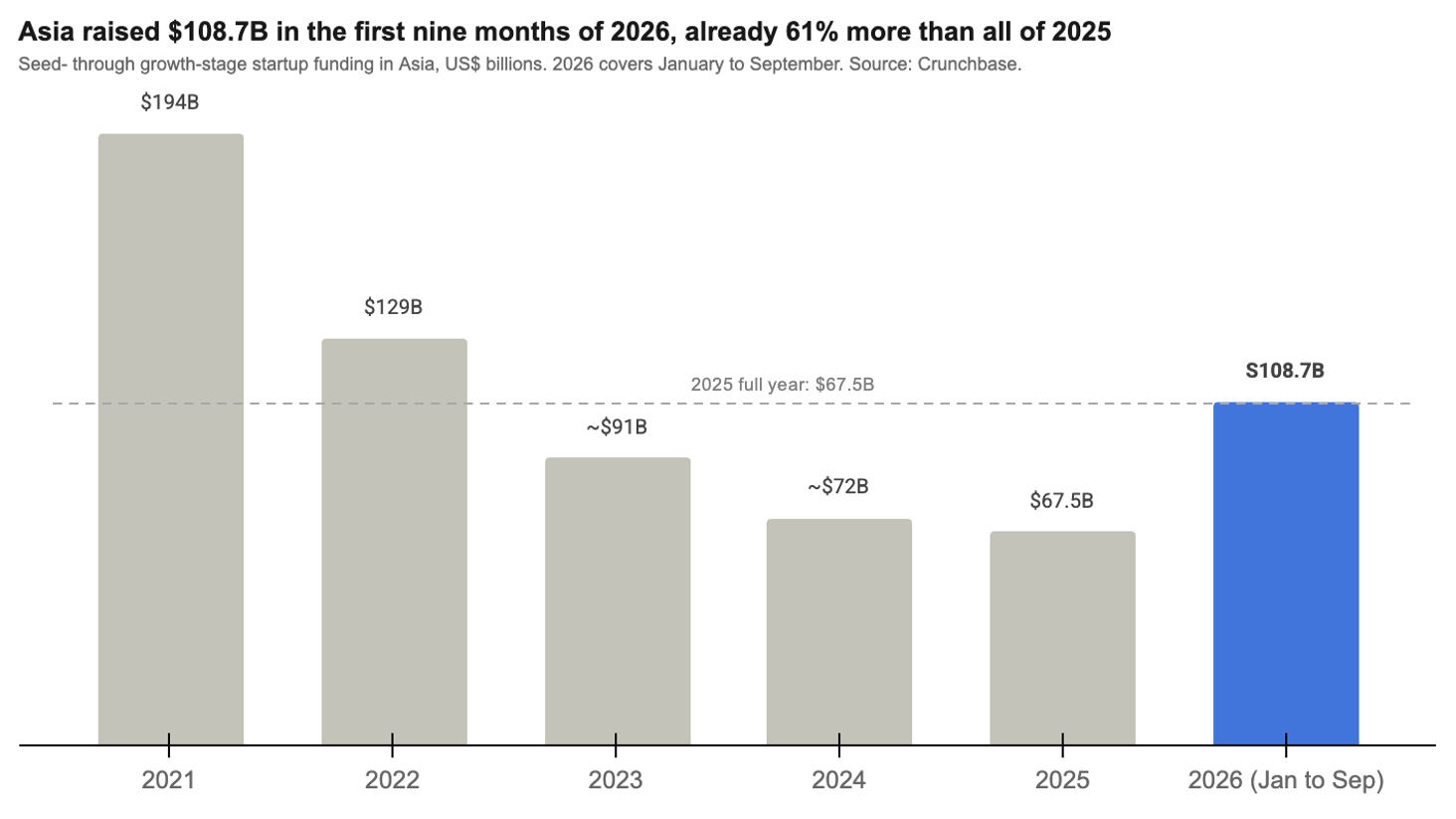
Asia’s startup funding peaked in 2021, led by China and India (Crunchbase). The correction that followed was deeper than in the United States. Funding fell from about $194 billion in 2021 to almost $129 billion in 2022, and by 2024 Crunchbase reported a 10-year low (Crunchbase). 2025 came in at $67.5 billion, down about 6% on 2024 and the lowest annual total in five years, though Q4 2025 turned higher (Crunchbase).
Then the market turned. Q1 2026 brought $27.4 billion, nearly double a year earlier. Q2 brought $42.8 billion, the highest quarter in more than three years, helped by DeepSeek’s $7.4 billion raise. Q3 brought $38.5 billion, still the second-highest tally of the cycle (Crunchbase). KPMG’s parallel data describe regional investment as strong by recent historical standards (KPMG).
2.2 A recovery of concentration, not breadth
The composition matters more than the total. In Q3 2026, roughly 70% of Asian startup funding went to China, and around 55% went to AI-focused companies. Moonshot AI’s $3.5 billion round and Kling AI’s roughly $3 billion round alone accounted for about a sixth of the quarter. Crunchbase observed that deal counts were relatively flat, so capital concentration remained pronounced (Crunchbase). In Q2, deal counts actually hit a multi-year low even as dollars soared (Crunchbase).
Crunchbase reports Asian seed funding at a multi-year high of $4.9 billion in Q3, but that regional figure is dominated by AI enthusiasm in a few hubs. Outside them, the picture is reversed.
2.3 Dollars up, deals down: the divergence in each market
| Market and period | Dollars | Deals or rounds | What it tells us |
|---|---|---|---|
| Asia, Q3 2026 | $38.5B, second-highest of the cycle | Relatively flat | Capital concentrating in favoured names |
| India, Jan–Sep 2026 | $10.3B, +7% | 1,134 rounds, −38%; seed −37% | Fewer, larger cheques; seed retreating (YourStory) |
| Southeast Asia, H1 2026 | $7.25B, best half since 2022 | 217 deals; early-stage deals 63% below H1 2022 peak | One $4.5B data-centre round drives the total (e27) |
| Korea, H1 2026 | ₩8.87T, record, +54% | Funded companies +17% | Broad growth, but mega-rounds dominate (Korea JoongAng Daily) |
Allocator One’s US data show the same pattern at global scale: rounds of $100 million or more took 87.5% of US venture dollars in H1 2026 (Allocator One). Asia is not an exception to the divergence. It is one of its clearest examples.
2.4 Liquidity is returning, starting in Hong Kong
The last piece of evidence is the most important for LPs. Hong Kong IPO proceeds in the first nine months of 2026 reached their highest level for that period since records began in 1980 (South China Morning Post). India’s tech IPO market remains active. A venture market with working exits is one in which disciplined early-stage capital can compound.
3. The structural drivers
Five forces explain why the current Asian cycle is different from 2021, and why it favours specialised early-stage capital over generalist growth money.
3.1 AI has moved from software to the physical economy
AI is now the majority of Asian venture dollars. AI-focused startups took more than 60% of Asian funding in Q2 2026, just over $26 billion and the highest sum on record (Crunchbase). What matters more for us is where that AI money is going next. KPMG’s Q3 2026 Venture Pulse reports that investors are moving beyond consumer tools toward model infrastructure, semiconductors, robotics and enterprise applications. In China, capital is targeting physical AI for manufacturing and logistics. In Japan, investors favour businesses with proprietary data and measurable implementation benefits (KPMG).
This matters because Asia, not the United States, holds the world’s densest concentration of factories, ports, logistics hubs and industrial supply chains. If AI’s next wave is about atoms as much as bits, Asia owns the deployment surface.
3.2 Governments have become patient anchor investors
Every major Asian market now treats venture capital as industrial policy. The scale is material.
| Market | Instrument | Scale | Status (2026) |
|---|---|---|---|
| Japan | Startup Development Five-Year Plan, extended by the 2026 Growth Strategy | Target of about ¥10 trillion annual startup investment by FY2027, 100 unicorns, 100,000 startups | Reaffirmed in the Cabinet’s July 2026 Growth Strategy (TIMEWELL) |
| Korea | Korea Fund of Funds (MSS) | ₩1.6 trillion for 2026, focused on AI, deep tech and regional startups | Record H1 2026 venture investment of ₩8.87 trillion (Korea JoongAng Daily) |
| Singapore | MAS Equity Market Development Programme | S$6.5 billion, expanded at Budget 2026 | S$5.4 billion placed across 14 managers by September 2026 (MAS) |
| China | Priority-sector policy and government guidance capital | Directed at robotics, semiconductors and industrial AI | Cited by KPMG as a driver of Q3 2026 momentum (KPMG) |
Japan’s ambition is especially striking. When the plan was launched in November 2022, annual startup investment was in the ¥800 billion range, so the target implies a more than tenfold increase (Cabinet Secretariat).
We treat these programmes with respect but not with naivety. Josh Lerner’s Boulevard of Broken Dreams remains the essential reference here. His central warning is that public programmes fail through poor design and implementation, and that governments cannot dictate how venture markets develop (Princeton University Press). The best programmes, in his account, act as catalysts that crowd in private managers rather than replacing them. Asia’s fund-of-funds structures increasingly follow that model, which makes them natural co-investors alongside independent emerging managers.
3.3 Exit channels are reopening, unevenly
Venture is ultimately a liquidity business. Hong Kong’s IPO market raised more than HK$388 billion from 116 listings in the first nine months of 2026, its strongest nine-month performance on record (KPMG China). More than half of those proceeds came from AI, semiconductor and robotics companies. India recorded 29 tech IPOs and 91 acquisitions in the same period (YourStory). Southeast Asia has a pipeline of more than 150 IPO candidates across Indonesia, Malaysia and Singapore (Bain). Japan remains the laggard: KPMG flags sluggish exits, higher rates and cautious LPs as live concerns.
Singapore’s equity-market reforms deserve particular attention from regional venture investors. A deeper SGX small- and mid-cap market is, over time, a credible exit route for the mid-sized Southeast Asian champions this paper is about.
3.4 The digital base layer is built
The consumer internet wave of the 2010s left behind infrastructure that the next generation of B2B and industrial companies can build on. Southeast Asia’s digital economy is on track to exceed $300 billion of gross merchandise value, after 7.4 times GMV growth and 11.2 times revenue growth in a decade, financed by about $120 billion of private funding (DealStreetAsia). Payments, logistics and identity rails now exist. The next winners will use them rather than build them.
3.5 AI is changing venture maths in favour of small funds
The final driver is the least discussed. Allocator One’s Keyvan Rahnamoon argues that AI is breaking the traditional financing ladder in the middle. In his comparison, a median SaaS company generates about $130,000 of revenue per employee, against about $1.1 million at the fastest-growing AI-native companies (Allocator One). Companies increasingly raise once, or raise billions. His conclusion is blunt: “Standing in the middle is no longer a strategy.”
In Asia, where Series B and C capital has always been thinner than in the United States, this is good news. A company that can reach profitability on a single seed or Series A round no longer depends on a growth investor arriving from San Francisco. And a small fund that owns 10% of such a company does not need a decacorn to return its capital.
4. Defining the venture hidden champion
A venture hidden champion is a company on track to lead a narrow, valuable niche in Asia’s real economy, built on modest capital and overlooked by large funds. The idea extends a well-tested concept from management research.
5. Seven investment themes
We see seven themes where Asia’s structural advantages meet the hidden-champion profile. In each, the headline capital is flowing to a few large platforms. The hidden champions sit one layer down, in the components, software and services those platforms depend on.
| Theme | Core markets | Evidence signal | Where the hidden champions sit |
|---|---|---|---|
| 1. Physical AI and industrial automation | China, Japan, Korea, Singapore | Robotics a top KPMG focus; D-Robotics’ $400M Series C | Task-specific robots, robot data and software, precision components |
| 2. AI infrastructure for a multi-polar Asia | Singapore, Malaysia, India, Japan | DayOne’s $4.5B round; Neysa’s $600M round | Cooling, power, inference efficiency, local-language data |
| 3. Vertical AI on proprietary Asian data | Japan, Southeast Asia, India | About 700 AI startups in SEA; AI about 30% of SEA funding | Industry workflows in manufacturing, pharma, trade, compliance |
| 4. Supply-chain re-wiring and advanced manufacturing | Japan, Korea, Malaysia, Vietnam, India | Japan VC focus on semiconductors, photonics, packaging, materials | Manufacturing software, trade compliance, university deep tech |
| 5. Embedded finance for the underbanked | Indonesia, Philippines, Vietnam, India | Digital financial services about half of SEA deal value | SME credit, B2B cross-border payments, regtech |
| 6. Energy and grid technology | Southeast Asia, India, Japan | AI power demand rising; climate fundraising near zero | Grid-edge software, storage management, C&I energy finance |
| 7. Health and longevity for ageing Asia | Japan, Korea, China, Singapore | Japan healthcare a named KPMG priority; diagnostics IPOs in India | Diagnostics, care automation, clinical-trial technology |
Theme 1: Physical AI and industrial automation
Asia’s factories and logistics hubs are the world’s largest proving ground for robots. KPMG China’s Angela Chiu explains the appeal: robotic functions “can be deployed immediately” in factories and logistics hubs, giving startups fast real-world validation and data (KPMG). Large rounds confirm the trend, including D-Robotics’ $400 million Series C in September 2026 (Crunchbase).
The general-purpose humanoid race will be won by a few heavily funded players. The hidden champions are elsewhere: robots built for one hard task, such as inspection, palletising or construction finishing; the data and simulation layer that trains them; and precision actuators, sensors and reducers, where Japanese and Korean suppliers have deep heritage.
Theme 2: AI infrastructure for a multi-polar Asia
Asia does not want to rent all its AI from one country. That creates demand for regional compute. Singapore-headquartered DayOne raised $4.5 billion in H1 2026, which on its own explained most of Southeast Asia’s funding for the half (DealStreetAsia). India’s Neysa raised $600 million for AI systems in Q1 (Crunchbase). Malaysia captured 32% of all Southeast Asian private AI funding in the latest e-Conomy period (Google Malaysia).
Data centres themselves are infrastructure assets, not venture assets. The venture layer is the enabling technology around them: liquid and immersion cooling for tropical climates, power management, inference optimisation, GPU orchestration, and training data in Bahasa, Thai, Vietnamese, Tagalog and India’s many languages.
Theme 3: Vertical AI on proprietary Asian data
Generic AI tools face a hard road. KPMG expects consumer AI tools to meet a tougher funding environment and further consolidation. By contrast, industry-embedded AI is attracting interest, especially in Japanese manufacturing and pharmaceutical development (KPMG Q2 2026). Southeast Asia has around 700 active AI startups, and roughly 30% of the region’s private funding over the past year went to AI (Bain).
The moat here is data that no global model provider can scrape: factory sensor histories, local-language contracts, customs records, medical images from Asian populations. Hidden champions combine that data with deep knowledge of a single workflow.
Theme 4: Supply-chain re-wiring and advanced manufacturing
The re-routing of global supply chains through Southeast Asia and India is now a decade-long project, not a headline. KPMG expects Japanese investors to focus on semiconductors, photonics, advanced packaging, materials and components (KPMG). Technology exports and data-centre investment are lifting Malaysia, Thailand and Vietnam (TechNode Global).
The hidden champions include software for small and mid-sized manufacturers, trade-compliance and origin-tracing tools, B2B procurement networks, and materials and photonics spin-outs from Japanese and Korean universities. India’s Skyroot Aerospace, one of the region’s $100 million-plus rounds in Q2 2026, shows how far this can extend into dual-use and space (KPMG).
Theme 5: Embedded finance for the underbanked
Digital financial services draw about half of Southeast Asia’s private funding value, and investors have focused on them as the region’s funding recovered (Digital News Asia). Lenders are now underwriting with transaction data, and digital wealth platforms are starting to reach scale (Bain).
Consumer lending is crowded and regulated. The hidden champions are in the plumbing: SME credit scoring for supply chains, cross-border B2B payments within ASEAN, embedded insurance and the compliance tools that let banks partner with fintechs safely.
Theme 6: Energy and grid technology
This is our most contrarian theme. AI compute is driving electricity demand across the region, yet capital for climate and energy startups is scarce. Only one climate-focused Southeast Asia fund reached a final close in all of 2025 (DealStreetAsia). Scarce capital meeting rising demand is exactly the condition under which disciplined early-stage managers earn their returns.
We favour asset-light models: grid-edge and demand-response software, battery and storage management, and financing platforms for commercial and industrial solar. We avoid technology bets that need project-finance scale before they can prove anything.
Theme 7: Health and longevity for ageing Asia
Japan, Korea, China and Singapore are ageing faster than any large economies in history. KPMG names healthcare among Japanese investors’ priorities for the coming quarter (KPMG). In India, Molbio Diagnostics was among the largest tech IPOs of 2026 by market capitalisation (YourStory).
The hidden champions include point-of-care diagnostics, care-home and home-care automation, and clinical-trial technology that uses Asia’s large and diverse patient pools. These companies often reach revenue through hospital and insurer contracts long before they reach public awareness, which fits the hidden-champion profile closely.
6. Market-by-market outlook
Our strongest conviction is in the markets where founders are capable, capital is scarce and exits are improving: India’s early stage, Southeast Asia and Japanese deep tech. Our stance on each market is summarised below, ordered from highest to lowest conviction for an emerging-manager allocation.
| Market | Latest data point | Our stance | Priority themes |
|---|---|---|---|
| India | $10.3B raised Jan–Sep 2026, +7%; rounds −38%, seed −37% | Overweight seed and Series A | 3, 4, 5, 7 |
| Southeast Asia | $7.25B in H1 2026, but $2.75B excluding one data-centre deal | Overweight, contrarian | 2, 3, 5, 6 |
| Japan | Full-year 2025 VC of more than $5.8B, second only to 2021 | Overweight deep tech with corporate partners | 1, 3, 4, 7 |
| Korea | Record ₩8.87T of venture investment in H1 2026 | Neutral to positive; deep tech only | 1, 4, 7 |
| China | About $27B in Q3 2026, roughly 70% of Asia | Selective; specialist access only | 1, 4 |
India: the clearest evidence of capital efficiency
India’s tech companies raised $10.3 billion in the first nine months of 2026, up 7%, while funding rounds fell 38% to 1,134 (YourStory). Seed funding fell 37% to $698 million (NewsBytes). On the surface that is a warning sign. Look one level deeper and it is an opportunity.
The six companies that became unicorns in this period raised an average of $101 million before their unicorn round, less than half the $205 million average a year earlier (YourStory). India is producing billion-dollar companies on half the capital, while seed capital is retreating. That combination is the hidden-champion thesis in a single statistic.
Southeast Asia: the most mispriced early stage in Asia
Southeast Asia raised $7.25 billion across 217 equity deals in H1 2026, its strongest half since early 2022 (e27). Strip out DayOne’s round and the figure falls to $2.75 billion. Early-stage deal count fell to 195, 63% below the H1 2022 peak. The 2025 full-year report described the market as having found a floor, not a launchpad (Thailand Business News).
The concentration is geographic as well as by deal. Singapore accounted for 91.5% of capital raised in Q1 2026 (DealStreetAsia), while the Philippines took just 1.1% of H1 funding (Daily Tribune). Meanwhile, the underlying economy is not waiting. Developing Southeast Asia is expected to grow about 4.6% in 2026 (TechNode Global). Temasek’s Fock Wai Hoong summarised the investor mood as prioritising “quality growth and efficient capital allocation” over deployment for its own sake (Digital News Asia). That is precisely the environment in which disciplined early-stage managers buy well.
Japan: deep tech meets patient corporate capital
Japanese venture investment exceeded $5.8 billion in 2025, second only to the 2021 record (KPMG). Investors remain highly selective in 2026, and exit conditions are the main weakness. But Japan offers something few markets can: corporations willing to provide proof-of-concept sites, manufacturing capability and quality control to startups commercialising complex technology. KPMG highlights exactly this corporate participation as a stabilising force (KPMG). Combined with the government’s ¥10 trillion target, Japan is building the conditions for a new generation of “global niche top” companies.
Korea: strong flows, concentrated outcomes
Korea’s H1 2026 venture investment of ₩8.87 trillion, about $6.34 billion, beat the previous first-half record set in 2022. AI, semiconductors and robotics led the way (Korea JoongAng Daily). New fund formation of ₩8.44 trillion was the second-highest on record. The caution is concentration: the Korea Times notes that a handful of mega-rounds account for an outsized share of the rebound (Korea Times). We are constructive on Korean deep tech, particularly components and industrial AI, but only through managers with genuine technical depth.
China: momentum, and where it’s going
China is the engine of Asia’s recovery. Chinese companies raised just over $30 billion in Q2 2026, up 424% year on year (Crunchbase), and about $27 billion in Q3. Hong Kong’s record listing year provides a working exit route. For many international LPs, however, sanctions, export controls and mandate restrictions limit direct exposure. We therefore treat China primarily as a source of competitive pressure and supply-chain opportunity for hidden champions elsewhere in Asia, and as an investable market only through specialist managers with clear compliance frameworks.
7. The emerging fund manager advantage
If Asia’s hidden champions are under-funded, the managers best placed to find them are under-funded too. That double scarcity is the core of our case.
The research on emerging managers is consistent, though most of it comes from US data. Cambridge Associates found that of the top ten US venture funds in each vintage from 2004 to 2016, 53% were run by managers on their first or second fund, rising to about 73% for managers on any of their first four funds (TechBullion, citing Cambridge Associates). The Kauffman Foundation’s review of its own portfolio found that first-time funds outperformed established firms by an average of 3.1 percentage points a year between 1997 and 2011. PitchBook data show close to 18% of first-time funds reaching a 25%-plus IRR, against roughly 12% of funds from seasoned managers.
Fund size matters as much as fund number. Of the annual top-ten venture funds between 2013 and 2022, 91% were smaller than $250 million and 73% smaller than $100 million (same source). A 2026 study by the Colibri Institute of 2,471 US funds raised between 2000 and 2024 found emerging managers outperforming established peers by an average of 7.2 percentage points of IRR (Colibri Institute).
We are careful not to over-claim. Asian fund-level performance data are thinner, survivorship bias is real, and the dispersion of emerging-manager returns is wide. The evidence supports a disciplined, diversified allocation to emerging managers, not an indiscriminate one.
7.1 The capital-formation gap
The paradox is that capital is moving away from the managers the evidence favours. In the US, established firms took 90.9% of venture capital raised in Q1 2026, the highest share PitchBook has recorded, and three firms took 48.1% of all US venture capital raised in H1 2026 (Allocator One). In Southeast Asia the squeeze is sharper. Fundraising for Southeast Asia-focused venture funds had its weakest half on record in H2 2025. No first-time manager reached a final close in that half, and only one did in the whole year (DealStreetAsia).
When the supply of early-stage capital collapses while founder quality holds, entry valuations fall and ownership rises. The managers who raise in such a window have historically been the ones who define the next vintage.
7.2 Specialists, not generalists
The market is also rewarding specialisation. Among new funds launched through VC Lab, the generalist share fell from 22% in 2020 to about 5% by early 2026 (Allocator One). In Asia, specialisation has a second dimension: geography. A manager who can source in Bahasa in Surabaya, underwrite a Japanese university spin-out or navigate Indian data rules has an edge that a regional generalist in Singapore or a global fund in California cannot easily replicate.
7.3 Small-fund maths in a raise-once world
The arithmetic is simple. A $20 million fund that owns 10% of a company returns the whole fund on a $200 million exit. A $1 billion fund with the same stake needs a $10 billion exit (Allocator One). Asia produces far more $200 million to $1 billion outcomes than decacorns, through trade sales to regional conglomerates, Japanese and Korean strategic acquirers, and listings in Hong Kong, Mumbai, Tokyo and, increasingly, Singapore. Small funds are built for the exits Asia actually generates.
There is a reporting consequence that LPs should anticipate. A capital-efficient company that never raises again will not be marked up. As Rahnamoon notes, the best raise-once portfolios may look worst on paper for years. LPs should judge such managers on portfolio revenue, profitability and the share of companies that no longer need external capital, not on interim marks.
7.4 What we look for in an Asian emerging manager
- Thesis depth. Demonstrable expertise in one of the seven themes, ideally from operating or technical careers.
- Local sourcing edge. Proprietary access in an under-served market or sub-sector, evidenced by founder references.
- Size discipline. A fund of roughly $20–150 million, sized to the exits the strategy can realistically generate.
- Ownership and reserves logic. Clear entry-ownership targets and a reserve policy that reflects the raise-once reality.
- Ecosystem partnerships. Working relationships with government funds of funds, corporate venture arms and later-stage co-investors.
- Governance and compliance. Institutional-grade administration, cross-border structuring and, where relevant, sanctions and export-control discipline.
- Alignment. Meaningful GP commitment and terms that reward realised returns rather than assets under management.
8. Risks and what could go wrong
The thesis depends on exits continuing to reopen and on the AI cycle broadening rather than breaking. Seven risks could undermine it.
| Risk | What could happen | How we mitigate it |
|---|---|---|
| Geopolitics and export controls | US–China restrictions tighten further, cutting off markets, components or capital for some companies | Favour companies whose customers and supply chains are diversified across ASEAN, India and Japan; require compliance frameworks from managers |
| AI concentration correction | Mega-round valuations reset, dragging sentiment across the asset class | Hidden champions are priced on revenue, not on frontier-model narratives; avoid themes dependent on a single platform |
| Exit disappointment | Japanese exits stay sluggish; Southeast Asian IPO candidates fail to list | Underwrite to trade-sale outcomes; keep fund sizes small enough that $200 million exits matter |
| Rates and currency | Higher rates or a strong US dollar compress local-currency returns | Diversify across currencies; prefer companies with dollar-linked or export revenue |
| Policy misallocation | Government capital crowds out private managers or chases fashionable sectors, as Lerner warns | Back managers who use public capital as an anchor, not as their only LP |
| Manager dispersion | Emerging-manager returns vary widely, and operational failures are more common | Diversify across managers, vintages and markets; diligence operations as rigorously as strategy |
| Data quality | Asian venture data are revised often and vary by source | Triangulate sources; treat any single figure as indicative |
The data-quality point deserves emphasis. For 2025, Google, Temasek and Bain put Southeast Asian private funding at about $8 billion, while DealStreetAsia counted $5.37 billion over the same year. The difference reflects scope and methodology rather than error (Second Talent). Crunchbase also revises earlier years upward as late-reported deals arrive. Our conclusions rest on the direction and shape of the data, which every source agrees on, rather than on any single number.
9. Conclusion and recommendations for LPs
Asia’s venture market has recovered in headline terms and diverged in substance. Capital has returned to a few companies, a few sectors and one dominant market. Below that line, capable founders across India, Southeast Asia, Japan and Korea are building niche leaders with less capital than any previous generation, and with fewer investors competing to back them.
Pomeranz showed that the original great divergence turned on access to scarce inputs, not on capability. The same is true today. The scarce input in Asian venture is specialist early-stage capital. Allocators who supply it, through the managers best placed to deploy it, will own the region’s next hidden champions at prices the megafunds will not see.
We make five recommendations to limited partners:
- Separate AI exposure from Asia exposure. Access frontier AI through global platforms if you want it. Do not mistake that for an Asian venture strategy.
- Build a dedicated Asian emerging-manager sleeve. Allocate to five to ten specialist managers with funds of roughly $20–150 million, diversified across India, Southeast Asia, Japan and Korea, and across at least three of the seven themes.
- Lean into the capital-formation gap now. Southeast Asian and Indian seed and Series A capital is at a cyclical low while founder quality is not. Vintages raised in such windows have historically been among the strongest.
- Co-invest alongside public anchors, not in place of private managers. Japan’s, Korea’s and Singapore’s programmes are strongest when they crowd in independent managers. Use them as partners and co-investors.
- Measure what matters. Judge raise-once portfolios on revenue, profitability and capital efficiency, not on interim markups.
The next decade of Asian venture returns will not be led by the companies on today’s front pages. It will be built quietly, niche by niche, by hidden champions. Our job, and the opportunity for our partners, is to find them before anyone else does.
References
Books and academic literature
- Lerner, J. (2009). Boulevard of Broken Dreams: Why Public Efforts to Boost Entrepreneurship and Venture Capital Have Failed — and What to Do About It. Princeton University Press. Publisher page
- Pomeranz, K. (2000). The Great Divergence: China, Europe, and the Making of the Modern World Economy. Princeton University Press. Publisher page
- Simon, H. (1996). Hidden Champions: Lessons from 500 of the World’s Best Unknown Companies. Harvard Business School Press; and Simon, H. (2022). Hidden Champions in the Chinese Century: Ascent and Transformation. Springer. EconPapers record
- Hosoya, Y. Japan’s Hidden Champions Hold the Key to Revitalization of Regional Economies. RIETI. Column
- Colibri Institute (2026). Why Emerging Venture Capital Managers Matter. PDF
Industry reports and data
- Allocator One (2026). Global Alpha Summit 2026: The Great Divergence.
- Rahnamoon, K. (2026). The Vanishing Middle Round. Allocator One. Article
- Crunchbase News (2022–2026). Asia quarterly and annual funding reports: 2021, 2022, 2023, 2024, 2025, Q1 2026, Q2 2026, Q3 2026
- KPMG Private Enterprise. Venture Pulse, Asia: Q3 2026, Q2 2026, Q4 2025
- KPMG China (2026). Chinese Mainland and Hong Kong IPO Markets: 2026 Q3 Review. Press release
- Google, Temasek and Bain & Company (2025). e-Conomy SEA 2025. Bain summary
- DealStreetAsia and Kickstart Ventures. Southeast Asia Startup Funding Report, H1 2026; SE Asia Venture Funds: H2 2025 Review (report); Southeast Asia Deal Review: Q1 2026 (summary)
- Tracxn (2026). India Tech 9M 2026 Report, as reported by YourStory
Policy documents
- Council of Economic Advisers (2026). Artificial Intelligence and the Great Divergence. Report page
- Cabinet Secretariat of Japan (2022). Startup Development Five-Year Plan (provisional translation). PDF
- Monetary Authority of Singapore (2026). MAS Appoints Third Batch of EQDP Asset Managers. Media release
- Ministry of SMEs and Startups, Korea (2026). H1 2026 venture investment data, as reported by Korea JoongAng Daily